Maine sought federal help amid its largest HIV outbreak in state history. It’s still waiting.

This story originally ran in the Boston Globe, Nov. 7, 2025.
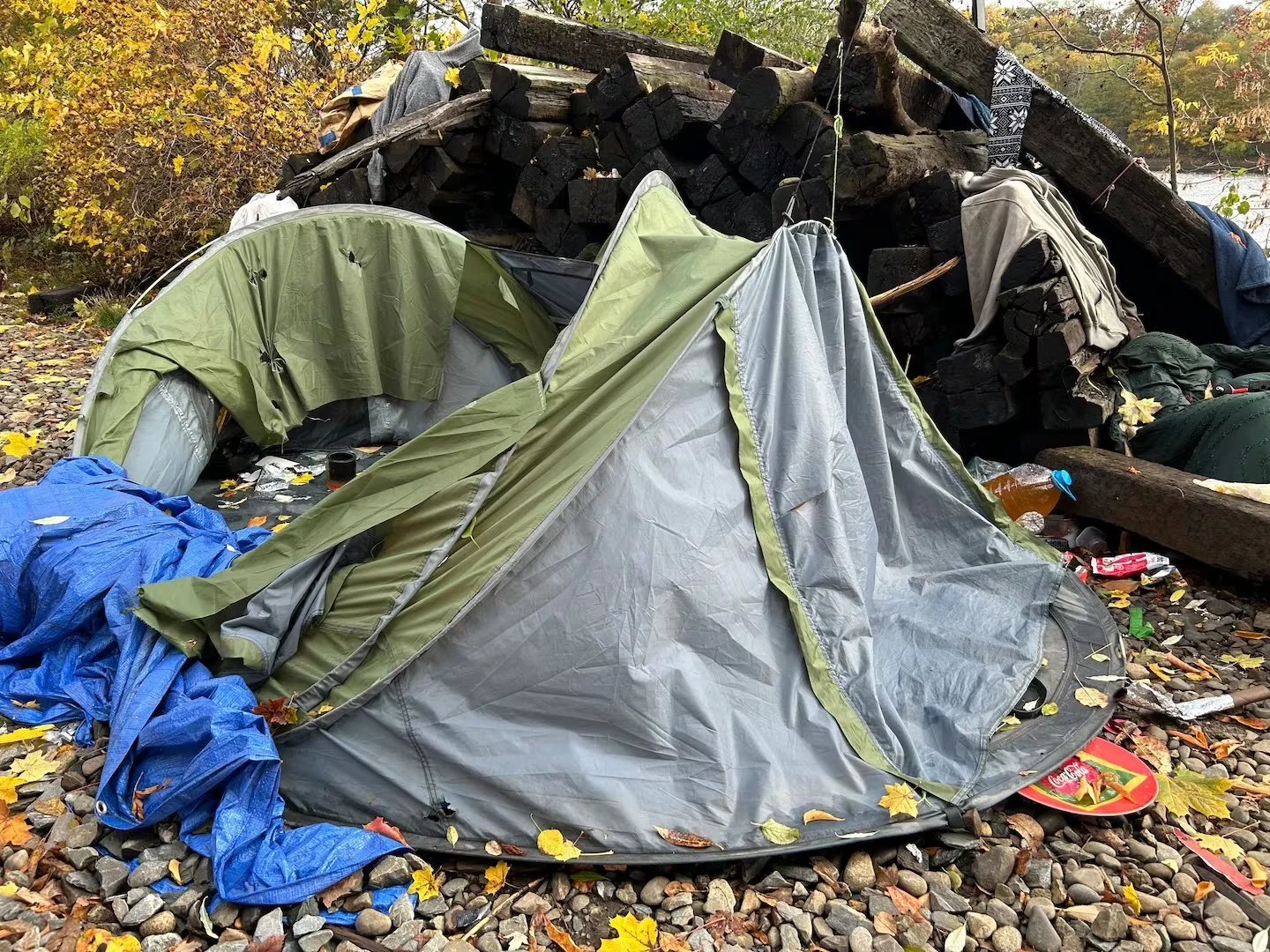
BANGOR — Steven Cronk, 41, sleeps among a row of tattered, sun-bleached tents that cling to a small strip of land between this city’s rusting railroad tracks and the Penobscot River. He estimated that most of the roughly five dozen people in this homeless encampment have HIV.
Cronk is among them. He is certain he was infected through a dirty needle and is still reeling from the diagnosis he received about a year ago.
“Some days I think I’ve got a handle on it, some days it just goes downhill,” said Cronk, who has spent much of his life homeless.
Penobscot County, which typically sees two new HIV cases a year, has reported 30 new infections since October 2023 — the biggest outbreak in state history. At the end of September, Maine public health experts asked for support from the Centers for Disease Control and Prevention, citing a “significant public health concern,” according to state documents requested by the Globe.
But after initially approving the request, the CDC put it on hold on Oct. 9. Travel isn’t authorized during the government shutdown, said Emily Hilliard, a spokesperson for the Department of Health and Human Services, which oversees the CDC, in response to a request for comment.
The decision to pause deployments of the support teams, called Epi-Aids, leaves Maine and other states with public health emergencies in limbo, another consequence of what has become the longest government shutdown in history.
State officials are planning for the team’s arrival after the shutdown ends, but have also been told that if the team didn’t deploy in October, it might not be available until February.
Federal authorities wouldn’t say how many Epi-Aid deployments are on hold, or whether such pauses happened during past shutdowns.
Spread mostly through dirty needles, the virus in Maine is entrenched among a homeless population in a part of the state short on resources to protect them.
Dr. Tom Frieden, who led the CDC during a shutdown in 2013, said the agency didn’t stop deploying staff during that two-week funding gap.

“We could respond to outbreaks,” he said. “It certainly did include travel.”
Other former CDC executives said the travel freeze represents an alarming deviation from agency norms. For decades, Epi-Aids have been readily available for health emergencies, both domestic and international, dispatched dozens of times a year.
“If the state asks for help, CDC always gives help,” said Dr. Demetre Daskalakis, the CDC’s former director of the National Center for Immunization and Respiratory Diseases, who resigned in protest over Robert F. Kennedy Jr.’s management. “It is pretty scandalous to me that CDC is not sending an Epi-Aid that Maine has asked for.”
Epi-Aids are typically staffed by experts in epidemiology and are on site for up to three weeks to provide training, education, and support. Maine is hoping the team can facilitate interviews with those affected by the outbreak.
The goal is to identify which interventions work, which don’t, and what new ones are needed.
It’s big-picture work that local and state public health workers, focused on providing direct services, haven’t had time to do.
“We’re burning ourselves out here on the ground,” said Jennifer Gunderman, Bangor’s public health director.
Gunderman is eager for the Epi-Aids interviews, which could provide new clues into how widely the virus has spread.
“People in Bangor think this is an outbreak of just people who are homeless,” Gunderman said. “I don’t think we’ve seen the full implications.”
The pause on Epi-Aids comes as the Trump administration plans to decimate the CDC’s HIV prevention program. The National Institutes of Health terminated this year nearly $800 million in HIV research grants.
Dr. John Brooks, a retired CDC HIV prevention and treatment expert, noted that in President Trump’s first term, the president prioritized preventing HIV’s spread.
“What changed in these people’s minds?” said Brooks, who led an Epi-Aid deployment to a similar HIV outbreak in Indiana a decade ago. “It’s such an unfortunate loss to take our eyes off this condition.”
Health experts note that a person infected with HIV typically requires at least $500,000 in medical care over a lifetime.
The cuts to HIV prevention and research bode ill for the country’s ability to respond to other similar outbreaks.
Nationally, HIV rates have been in decline, but intravenous drug use is driving outbreaks in rural parts of the country, such as Maine. Unlike in big cities, resources for homelessness, addiction, and harm prevention in these communities are scarce. Over the past decade, rural parts of Kentucky, Ohio, and West Virginia have reported surges in HIV infections.
In 2023, Penobscot County had the second-highest number of overdoses, both fatal and nonfatal, among all Maine counties, state data showed, which only hints at the extent of the region’s addiction troubles, said Gunderman.
A now-defunct homeless encampment facilitated the spread of the virus, but closing it in February made it harder to contact and treat the people at risk, health experts said.
The outbreak is sustained and exacerbated by the privations of homelessness. For people with nothing, sex becomes an asset to trade for drugs or shelter, Gunderman said, and the virus is exchanged along with it.

Patients with transient lives often can’t keep up with prescriptions or can be targeted by thieves when they do, and access to medical care is scarce.
“I have patients that sometimes drive three or four hours to come to appointments,” said Dr. Scott Melton, lead physician at Northern Light Eastern Maine Infectious Disease Care in Bangor, the region’s only practice specializing in infectious diseases.
The Maine surge coincides with an outbreak of hepatitis C, a blood-borne disease that damages the liver.
“I had not heard about an outbreak until a week or two ago,” said Kira Jimenez, a 38-year-old staying in Bangor who said she caught hepatitis C by sharing needles last year.
She hasn’t used in months, she said, but plans to soon get a test to confirm she hasn’t been exposed to HIV.
Bangor is making strides to cope with the outbreak, including investing $550,000 in opioid settlement money for case management services and, as of last Thursday, a second, much-needed syringe exchange site operated by the advocacy group Needlepoint Sanctuary.
Willie Hurley, the organization’s executive director, said it’s a struggle to persuade the homeless population to prioritize HIV prevention.
“HIV is abstract compared to extreme poverty or dope sickness,” he said.
For some, the efforts have had an effect. Jessica Emery, who huddled in the doorway of a vacant Bangor storefront late last month, said she visits a needle exchange every three days.
Patients with transient lives often can’t keep up with prescriptions or can be targeted by thieves when they do, and access to medical care is scarce.
“I have patients that sometimes drive three or four hours to come to appointments,” said Dr. Scott Melton, lead physician at Northern Light Eastern Maine Infectious Disease Care in Bangor, the region’s only practice specializing in infectious diseases.
The Maine surge coincides with an outbreak of hepatitis C, a blood-borne disease that damages the liver.
“I had not heard about an outbreak until a week or two ago,” said Kira Jimenez, a 38-year-old staying in Bangor who said she caught hepatitis C by sharing needles last year.
She hasn’t used in months, she said, but plans to soon get a test to confirm she hasn’t been exposed to HIV.
Bangor is making strides to cope with the outbreak, including investing $550,000 in opioid settlement money for case management services and, as of last Thursday, a second, much-needed syringe exchange site operated by the advocacy group Needlepoint Sanctuary.
Willie Hurley, the organization’s executive director, said it’s a struggle to persuade the homeless population to prioritize HIV prevention.
“HIV is abstract compared to extreme poverty or dope sickness,” he said.
For some, the efforts have had an effect. Jessica Emery, who huddled in the doorway of a vacant Bangor storefront late last month, said she visits a needle exchange every three days.
“I had a life, I’m trying to get back to that,” said Emery, 43, who worked as a certified residential medication aide before becoming homeless about a year ago. “I don’t want to catch anything while I’m out here.”
On a recent Friday, Cronk walked the desolate railroad tracks toward his tent. The nearby river reflected the orange and auburn foliage of late autumn. He acknowledged a small piece of good news: his girlfriend, who is pregnant, recently tested negative for HIV.
The roughly beautiful surroundings belie a precarious existence, he said. He and his girlfriend found their tent slashed and their food stolen a few nights earlier. They slept that night in a corner of the tent that gave a little shelter against heavy rain.
He’s not using drugs, Cronk said, but over the past month hasn’t been able to afford the medications he needs.
“Every day I feel like I’m dying,” he said.