Harassment and violence have become routine at Tewksbury’s overburdened psych hospital, workers say
This story originally ran in the Boston Globe, March 16, 2024.
TEWKSBURY — An influx of patients from the criminal justice system is overwhelming a Massachusetts psychiatric hospital, contributing to overcrowding and dangerous conditions at a facility ill-equipped to properly care for them.
At Tewksbury Hospital, one of five residential psychiatric facilities run by the state’s Department of Mental Health, treatment sessions have been held in broom closets; staff complain of groping, threats, and assaults; and local police have responded to violent incidents and patients wandering off the property, according to town records, state data, and interviews with current and former workers.
The problems are not unique to the Tewksbury facility, said people familiar with the hospital’s operations, but rather are emblematic of an already stretched state mental health system that in recent years has been further strained by an influx of patients arriving through the criminal justice system. Waits for inpatient care at DMH facilities soared from 35 days in 2015 to 293 days in 2021, according to a report the Department of Mental Health issued in April.
“You’re having a backlog to the entire system,” said Karen Coughlin, a board member of the Massachusetts Nurses Association, a union representing nurses in the state hospital system, and a retired nurse who worked with criminal justice patients at Taunton State Hospital. “All of this is creating a horrible standard of care.”
People admitted to state hospitals through the criminal justice system, called forensic patients, typically arrive in one of two ways: through court referrals for psychiatric evaluations or as transfers from the Bridgewater State Hospital, the Department of Corrections’ mental health hospital. Since 2018, transfers from Bridgewater have doubled to more than 200 in 2023, contributing to a 10 percent systemwide increase in forensic patient admissions. Court referrals, which dropped during the pandemic, have risen again.
The result, hospital workers said, is substandard treatment and difficult working conditions. The Globe spoke with a dozen current and former workers at Tewksbury who described feeling consistently overwhelmed at work and perpetually on guard against the possibility of violence. The workers interviewed included daily care providers and staff responsible for treatment. None were willing to be quoted by name, saying they could face retribution at work.
The conditions at Tewksbury and other DMH hospitals mirror a national mental health crisis. During the pandemic, many who needed care lost access to therapists. Among them were people who descended into homelessness and addiction and committed offenses that drew police attention.
“You can think of it as a public health crisis that gets manifested in our legal system,” said Daniel Murrie, director of psychology at University of Virginia Law School’s Institute of Law, Psychiatry and Public Policy, who has identified an increase in court-ordered competency evaluations creating strain on mental health networks nationally.
A 2023 DMH report noted the increase in court referrals helped people in the criminal justice system find treatment. It also acknowledged, though, that those patients have contributed to an overall increase in the average length of treatment and delayed admissions for others seeking treatment who don’t come by way of the criminal justice system.
The report included plans to reduce the long waits for admission by 100 days and add 65 inpatient beds over three years. It said it would also invest in 500 beds in group homes.
“We recognized that with the resources that we have, we needed to extend our capacity,” said Brooke Doyle, commissioner of the Department of Mental Health.
At Tewksbury, forensic patients now live alongside other patients, creating an exhausting blend of demands on workers, who have much of their time absorbed by the forensic patients. Those patients often arrive unmedicated and without recent mental health care, said Coughlin. Meanwhile, patients already struggling with mental health difficulties become witnesses to aggressive or destructive behaviors.
“It is traumatic for everyone,” Coughlin said.
As of the second week in March, about 43 percent of patients in Tewksbury’s mental health units had a connection to the criminal courts, according to SEIU 509, the union representing many DMH workers.
Tewksbury Hospital has medical units as well as psychiatric ones, allowing it to provide both medical and mental health care. That is one reason for its swelling population, said Jean Calvert-McClure, chapter president for SEIU 509.
Overcrowding has been a consistent issue at Tewksbury Hospital since the middle of 2022, DMH data show. The hospital reported having more patients than beds through the middle of 2023. Creating an additional mental health unit in July brought another 21 beds, which patients promptly filled and exceeded. As of December, the hospital reported having 165 beds, but 176 patients.
The new beds came at the expense of treatment spaces or activity areas, said workers. One noted that mental health treatment has taken place in spaces that had been used as broom closets.
“These patients have nowhere to go,” a former nurse at the hospital said.
A DMH spokesperson said the department had not received reports of treatment in closets.
Staffing levels have also fallen short. While Tewksbury’s mental health units have added staff over the past two years, they had fewer workers in 2023 than in 2019, when the bed count was 8 percent smaller, according to DMH data. Registered nurses are particularly scarce. Tewksbury had 14 fewer registered nurses in 2023 than 2019.
DMH has hired temporary workers, but the department acknowledged it is struggling to find qualified employees in the midst of a national workforce shortage in health care.
Tewksbury has no forensic psychologists on staff. It relies on contracted psychologists to conduct court-ordered evaluations, which DMH said gives it flexibility to shift those experts throughout the hospital system as needed. Evaluations are supposed to be performed within 20 days, but in some cases the wait is longer, according to a Tewksbury staffer who has direct knowledge of the process.
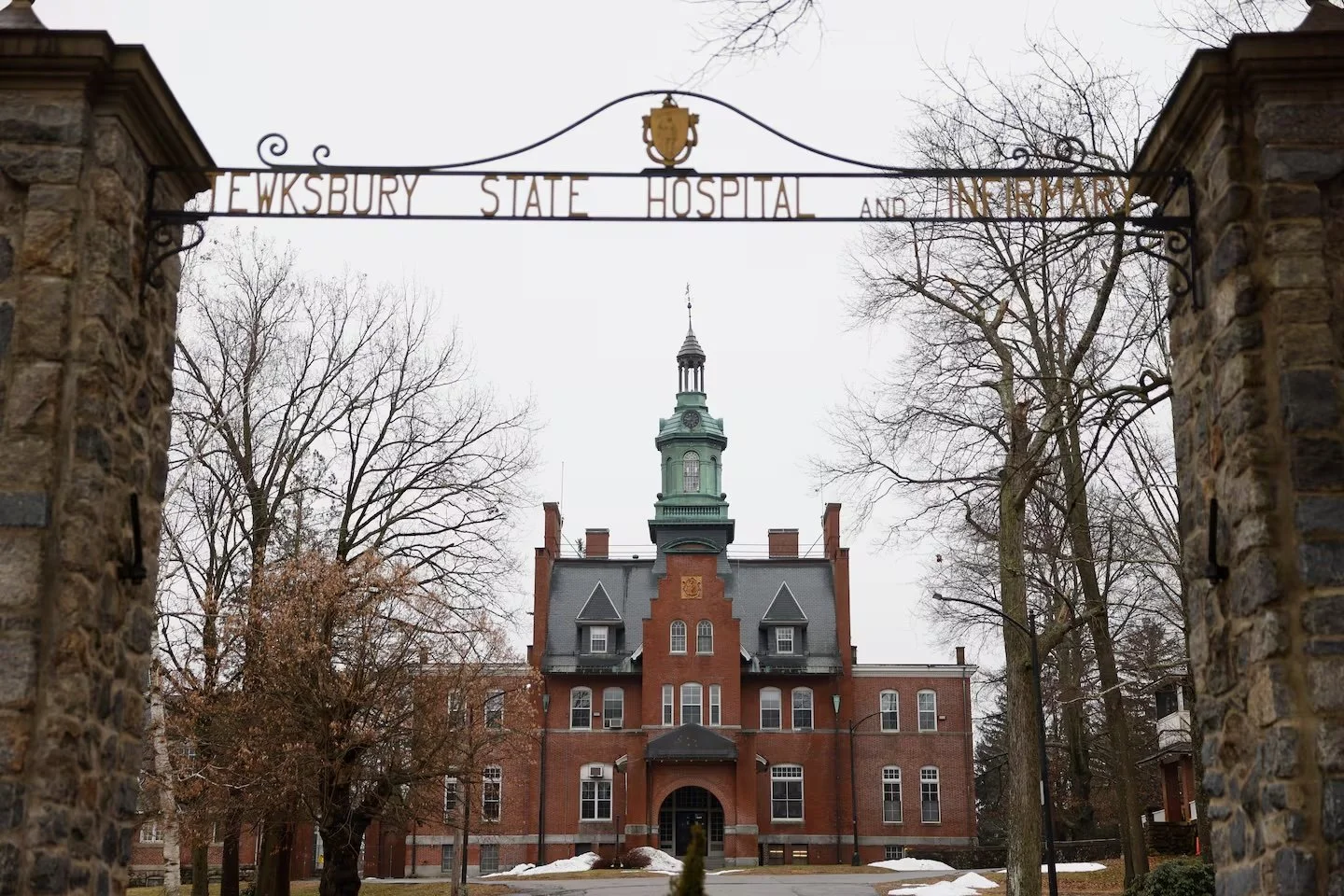
Many workers said Tewksbury Hospital simply wasn’t built to care for its current mix of patients. Established in the mid-19th century as an almshouse, the hospital’s centerpiece is a majestic brick administrative building that now houses a museum. But today’s mental health patients reside on the upper floors of a 56-year-old monolith at the rear of the sprawling campus.
Doors on the mental health wings are locked, but security is more lax on the lower floors, which are not dedicated to mental health care, and some psychiatric patients have simply walked out, workers said. The Tewksbury Police Department reported being called nine times last year for patients who left the grounds without permission, the Police Department reported.
Meanwhile, opportunities for patients to receive sanctioned outdoor time are limited, several workers said. Getting to the only restricted outdoor space, a fenced courtyard a little larger than a basketball court, involves, “a lot of angry people in a tiny elevator,” one worker said.
As much as 10 minutes of some forensic patients’ allotted half hour of outdoor time may be spent just traveling to the secure outdoor area, workers said.
“Fresh air is a human right and we do have procedures in place to offer fresh air to our patients,” said Doyle, the DMH commissioner.
The Disability Law Center, a Massachusetts advocacy group, conducts monthly inspections of Tewksbury and is concerned that the conditions at the hospital hurt patients’ recovery.
“I think we may be holding them back,” said Tatum Pritchard, the center’s director of litigation.
Doyle acknowledged issues stemming from the building’s age but said the department has “specific procedures to assure safe movement within and around the facility.”
All too often, though, workers said, the close quarters and tense environment erupt into violence. The administrators of a mental health facility must by law notify the county district attorney of any incident they believe to be a crime potentially punishable by imprisonment. Tewksbury filed 23 such reports in 2023 and 47 in 2022, according to a spokesperson for the Middlesex District Attorney’s office, who said she could not provide details on the reports for privacy reasons. Seven have been filed so far this year.
“You’re waiting for violence,” said a former Tewksbury mental health worker. “You better hope there’s enough staff there to help you.”
She said a forensic patient punched her in the face in 2022 as she put away another patient’s clothes, giving her a black eye. The former employee is still a state worker and asked not to be named due to fears of retribution.
Threats of violence, including rape, directed at women are common, several workers said.
Doyle said the department and hospital are in frequent contact with workers’ unions and are aware of the safety concerns.
Coughlin, the representative from the nurses union, noted workplace violence for health care workers overall has increased since the pandemic. She said incidents of violence are typically underreported in the state’s psychiatric hospitals. Workers often aren’t supported by hospital administration if they want to press charges and risk being moved away from colleagues they like if they complain about a patient, she said.
In 2021, a patient at Tewksbury nearly strangled a staffer, according to reports by the Lowell Sun, prompting the hospital to create a way for staff to submit complaints anonymously. DMH reported the system received 135 complaints in 2023 but that most of them were about issues such as snow removal or parking. Workers said they don’t use the system for more serious matters because they fear it wouldn’t get results.
“There is not a culture where it’s safe to complain,” one worker said.
Despite their concerns about safety, staff at Tewksbury are intensely protective of the patients. Several were reluctant to be interviewed over concerns that a story reporting on the hospital’s conditions would vilify the people living there.
“They’re really unwell,” one worker said. “They’re all under-slept, overwhelmed, overstimulated, angry to be there … and all of that comes out behaviorally.”